Secure Software Development
https://nsc.aoeu.com/csb435/week-03
Bash Bash - SSH edition!
Let's CLI like it's goin' out of style
Class at a glance
------- Mo Tu We Th Fr Sa Su
01  APR  6  7  8  9 10 11 12
02  APR 13 14 15 16 17 18 19  assignment 1
03  APR 20 21 22 23 24 25 26  cp 1
04  A/M 27 28 29 30  1  2  3  assignment 2
05  MAY  4  5  6  7  8  9 10  cp 2
06  MAY 11 12 13 14 15 16 17  CLASS REMOTE / assignment 3
07  MAY 18 19 20 21 22 23 24  cp 3
08  MAY 25 26 27 28 29 30 31  assignment 4
09  JUN  1  2  3  4  5  6  7  cp 4
10  JUN  8  9 10 11 12 13 14  ripen final
11  JUN 15 16 17 18 19 20 21  no class! Go graduate!
The Early Web
In the mid-1990s, I wrote a web forum
- Users could post messages
- Others could reply
- All in a web browser
- Written in C
I thought I was pretty clever.
Math Problems
Users started posting messages with math in them.
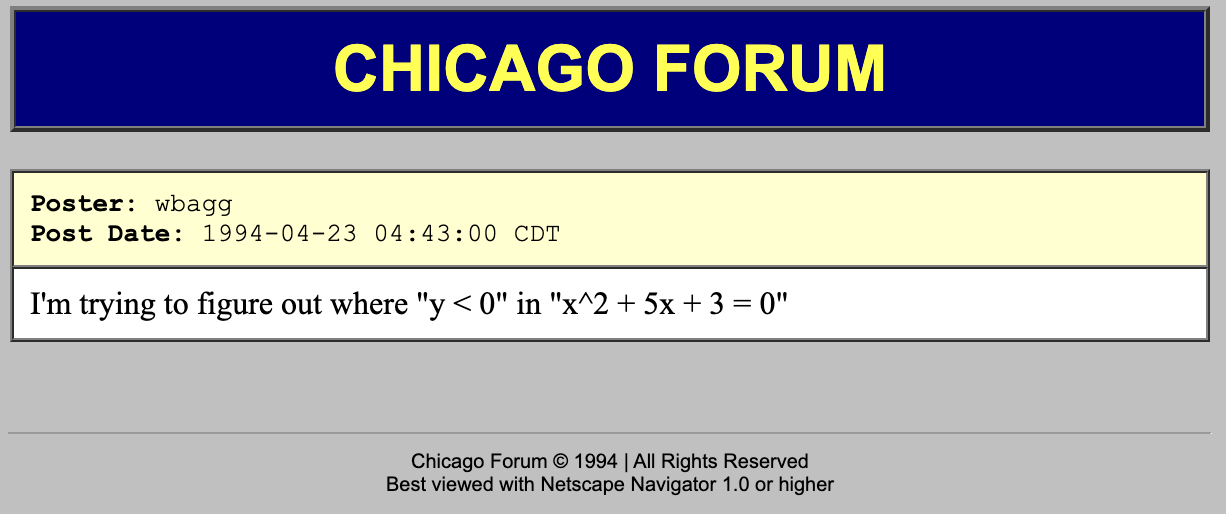
What do you think happened?
Less than zero
The < character was interpreted as HTML tag start.
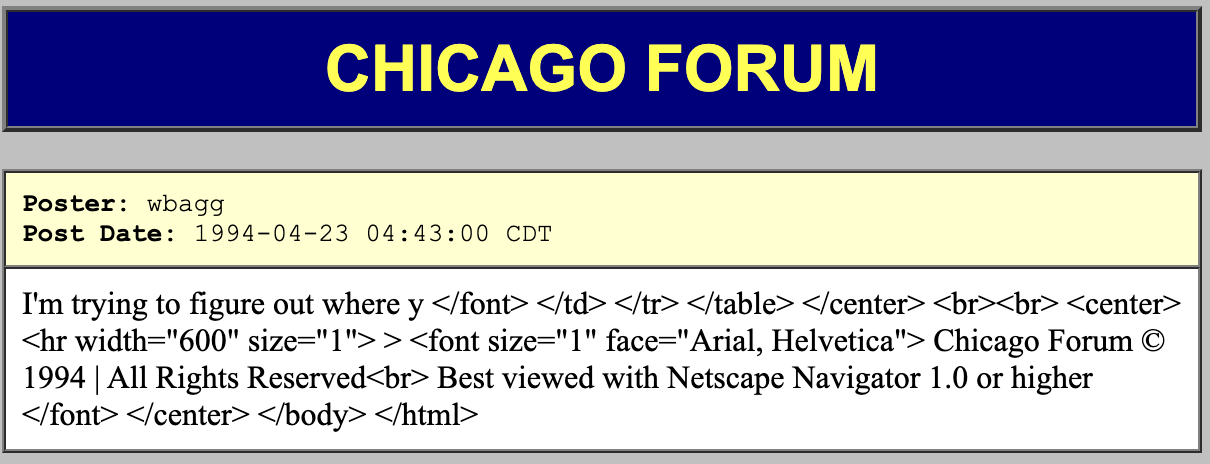
Under the hood
This is what the html looked like:
    <p>
    Poster: wbagg<br>
    Date: 199x-04-23 04:43:05<br>
    <p>
    I'm trying to figure out where "y < 0" in "x^2 + 5x + 3 = 0"
    <center>
    <hr width="600" size="1">
    <font size="1" face="Arial, Helvetica">
YCPGW?
This is bad, but is it a security problem?
Thing that could go wrong
- Injecting HTML markup
- Injecting javascript
- Injecting iframes
- Injecting SSIs
Server Side Includes
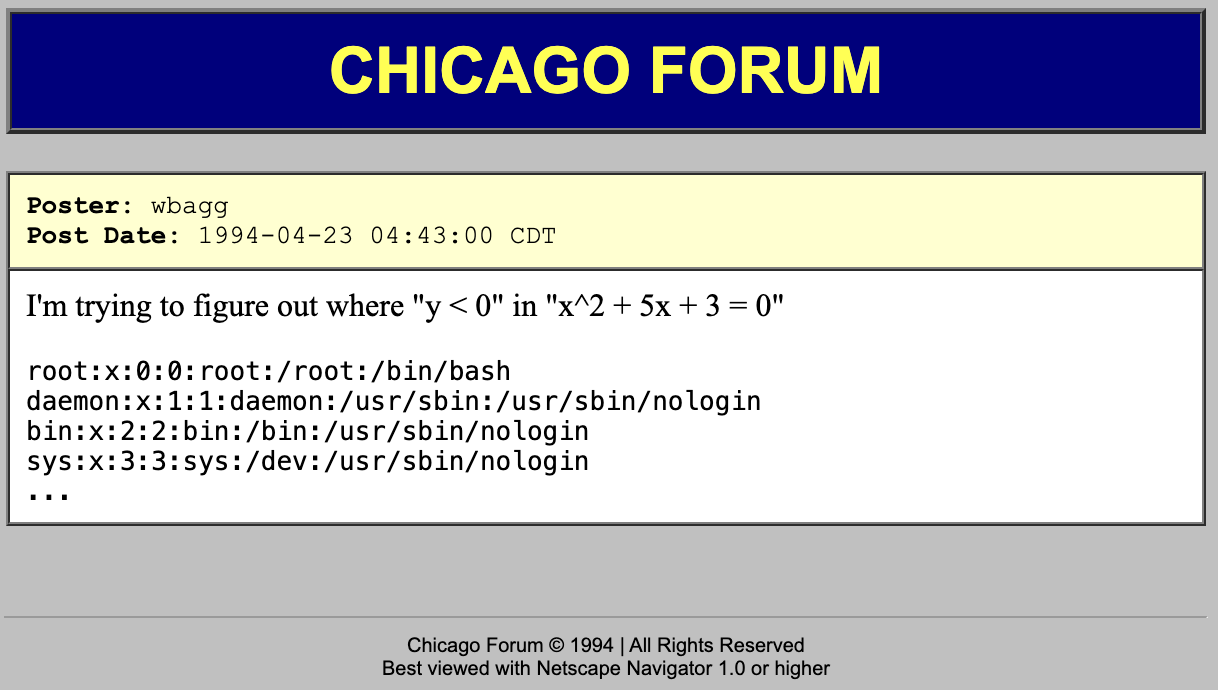
<pre>
<!--#include virtual="/etc/passwd">
</pre>
Simplistic fix?
for (i = 0; i < length; i++) {
ch = str[i];
if (ch == '<') {
printf("<");
} else {
printf(ch)
}
}
Problem solved! Right?
Escape from HTMLcratraz
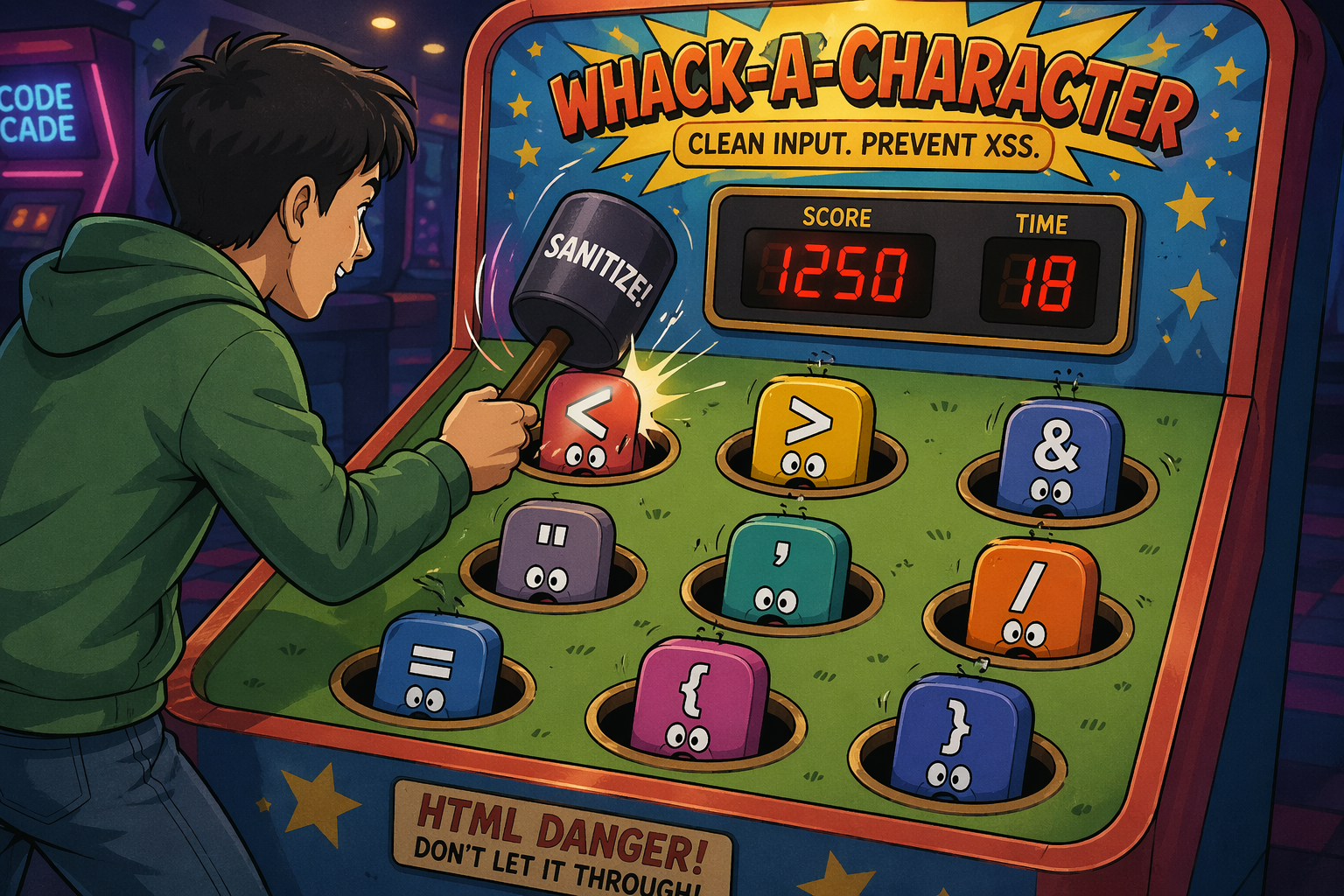
Over weeks, I kept finding new characters to escape.
- More and more testers finding buggy escape issues
- Each time I added another character to my list
- This is how things go wrong in security.
- We'll cover sanitization next week!
Happy Conservatives
Lab #1 !
Injection Attacks
Injection Attack: when user input changes the meaning of commands or content
- SQL injection
- Command injection
- Code injection
These are always in the CWE Top 25 and OWASP Top 10 most common security flaws.
Not the Botox kind
Four conditions create injection vulnerability:
- Program uses a command interpreter
- Commands constructed dynamically at runtime
- User input used to construct commands
- Program fails to prevent input from changing command meaning
Attack Surface
User input enters your program from many sides
- Web forms/POST
- URL query params / path components
- API data
- File contents
- Network packets
- Command-line arguments
- Environment variables
- Direct user input (
stdin)
Bobby Tables (cont)
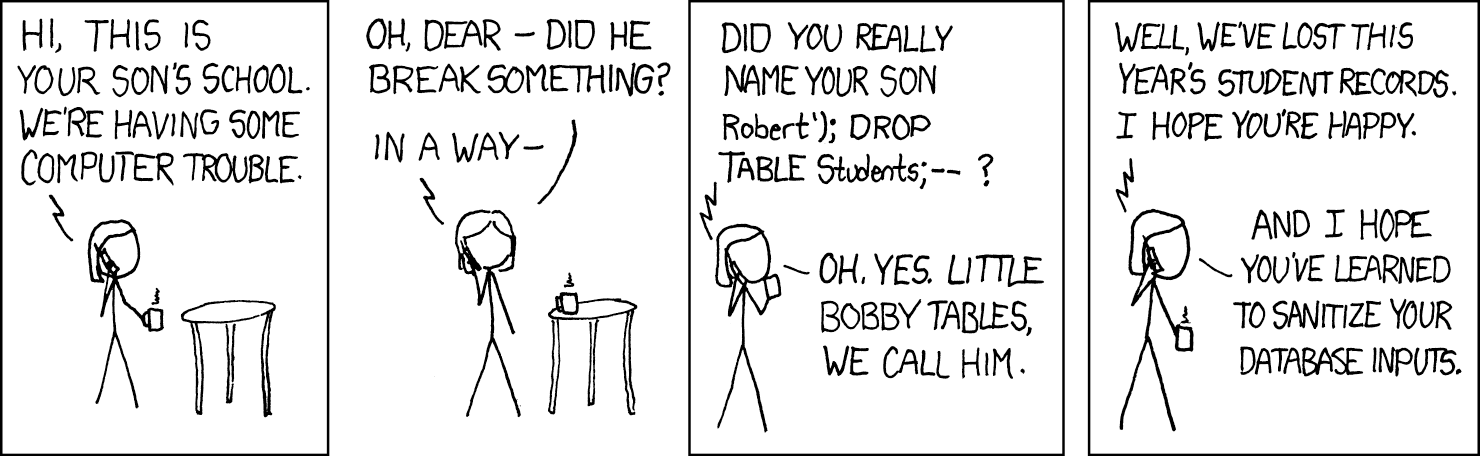
INSERT INTO Students (firstname) VALUES ('Elaine');
vs
INSERT INTO Students (firstname) VALUES ('Robert'); DROP
    TABLE students; --');
SQL Basics
SELECT * FROM users WHERE username = 'alice';

INSERT INTO products (name, price) VALUES ('Widget', 9.99);

UPDATE accounts SET balance = 1000 WHERE id = 42;

DELETE FROM logs WHERE date < '2025-01-01';
Straightforward when queries are static.
Dynamic SQL Construction
Real applications need to build queries from user input:
username = get_user_input()
query = "SELECT * FROM users WHERE username = '"
        + username + "'"
execute(query)
Anatomy of the Attack
SELECT *
  FROM users
  WHERE username = 'Robert'; DROP TABLE users; --'
Three techniques used:
- Metacharacter injection (quote to close original string)
- Statement separator (semicolon)
- Comment to neutralize remaining text (
--)
Would you like to play a game?
Try csb435/week-03/login_vulnerable.py
$ ssh class.nsc.aoeu.com
$ cd csb435/week-03/
$ ./login_vulnerable.py
Username: admin
Password: not-treefrogs

Executing query: SELECT *
                 FROM users
                 WHERE username='admin'
                 AND password='not-treefrogs'

LOGIN FAILED
Invalid credentials
Attack #1
Query Code:
query = "SELECT * FROM users WHERE username='" + user
        + "' AND password='" + pass + "'"
- Username:
admin' -- - Password: (anything)
SELECT * FROM users WHERE username='admin' --' AND password='foo'`
Attack #2
Query Code:
query = "SELECT * FROM users WHERE username='" + user
        + "' AND password='" + pass + "'"
- Username: (anything)
- Password:
' OR '1' = '1
SELECT * FROM users WHERE username='foo'
         AND password='' OR '1' = '1'
Attack #3
SELECT * FROM users WHERE username=''
 UNION SELECT
    NULL,
    group_concat(username || ':' || password || ':' || role, ' - '),
    'x',
    'admin'
 FROM users --' AND password='foo'

LOGIN SUCCESSFUL
Welcome, admin:treefrogs:admin - alice:CryptoIsFun:user - bob:ipreferjava:user ...
How NOT To Fix SQL Injection
Bad Idea #1: Input Validation
Only allow alphanumeric characters?
- O'Brien is a valid name
- International names with special chars
- Legitimate data might need quotes
- Faleshoods about names
How NOT To Fix SQL Injection
Bad Idea #2: Escaping Quotes
Replace ' with '' or \'?
- Complex escaping rules
- Easy to get wrong
- Different for each database
- Miss one spot and you're still vulnerable
SQL Injection protection: Prepared Statements
stmt = db.prepare(
    "SELECT * FROM users WHERE username = ? AND password = ?"
)
stmt.setString(1, username)
stmt.setString(2, password)
result = stmt.executeQuery()
?are placeholders for data- Data is NEVER parsed as SQL
- Database handles all escaping
- No way for user input to become commands
You gotta keep 'em separated
Separation of Code and Data
- SQL structure sent to database first
- Database compiles/prepares the query
- Parameters sent separately
- Data inserted without parsing
- No metacharacters can change query meaning
'; DROP TABLE users; -- is treated as a literal username.
Command Injection
Executing shell commands from your program
Many languages provide this:
Runtime.getRuntime().exec(),ProcessBuilder()in Javapopen()in C, Pythonsystem()in C, Python, Rubyexec()in PHP, Pythonshell_exec()in PHP- Backticks in Perl, Ruby, PHP
subprocess.run()in Python- Variable expansion in Shell
Hard or soft 'g'?
#!/usr/bin/env python3
import os, sys

image_name = sys.argv[1]
base = image_name.rsplit(".", 1)[0]
output = base + ".gif"

cmd = f"magick {image_name} {output}"
os.system(cmd)
Hard or soft 'g'?
Input: foo.png ; rm -rf /
Resulting command: magick foo.png ; rm -rf / foo.gif
- Semicolon separates commands
- Second command deletes everything
- Executes with your program's privileges
Shell Metacharacters
Many characters have special meaning in shells:
| Character | Meaning |
|---|---|
; |
Command separator |
& |
Background execution |
\| |
Pipe output to next command |
` |
Command substitution |
$() |
Command substitution |
> < |
Redirection |
\n |
Newline (command separator) |
How To Prevent Command Injection
Best practice: Don't use shell commands
- Use builtins/libraries instead:
- e.g.
Files.delete()os.unlink()vs runningrm {filename}
- e.g.
How To Prevent Command Injection
Use explicit arguments as lists, not strings when running shell commands
| Vulnerable | Good |
|---|---|
os.system(f"rm {filename}")
|
subprocess.run(["rm", filename])
|
Runtime.getRuntime()
  .exec("rm " + filename);
|
Files.delete(Path.of(filename)); |
Command Injection Defenses
If you must build command strings:
- Validate input against strict allow list
- Reject dangerous metacharacters:
; | & $ ( ) < > \n \`` - Never try to "fix" input - reject it instead
- Use shell escaping functions from your language
But really, use builtins / libraries where possible.
Two subtle a vulnerability
What's wrong with this python code?
content = input("Say something witty: ")
print(f'You said {content}')
Two decades of bad design
What's wrong with this python code?
content = input("Say something witty: ")
print(f'You said {content}')
In python2, input() was "read + eval" under the hood.
Say something witty: 5 + 7 * 2
You said 19
Python2 had raw_input() added later, which became input in Python3.
Code Injection
Dynamic code execution in interpreted languages:
eval()in Python, JavaScript, Ruby, Perl, PHPexec()in Pythoncompile()in Python- Regular expressions with
/eflag in Perl
Code Injection Example: Calculator
expression = input("Enter calculation: ")
result = eval(expression)
print("Result:", result)
...

Enter calculation: __import__('os').system('rm -rf /')
__import__loads modules dynamicallyos.system()executes shell commands- Your calculator is now a remote shell
Code Injection Defenses
Best practice: Never use eval() or dynamic code execution
If you absolutely must:
- Validate input with strict allow lists
- Reject any metacharacters: quotes, semicolons, etc.
- Consider using restricted execution environments
- Use language-specific safe alternatives
But really, redesign to avoid it.